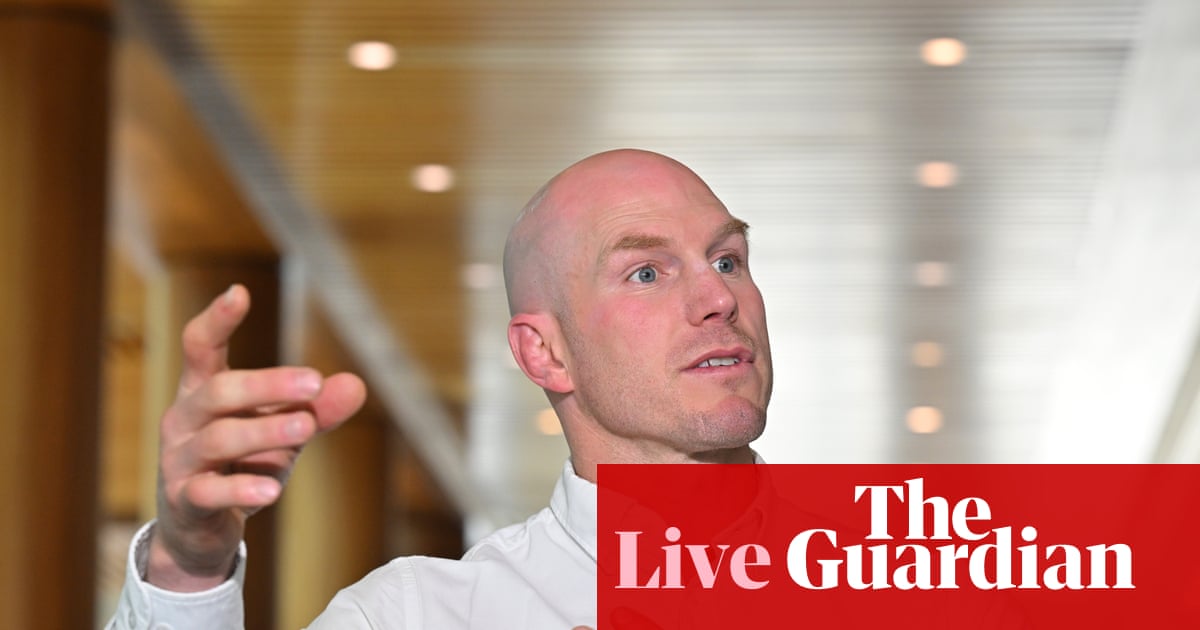
Future Fund sends staffer on a $20,000 hotel scoping trip, estimates reveals
Krishani Dhanji
The Future Fund CEO has revealed that his former executive assistant went on a scoping trip to the US “to assess hotels as to their suitability for our staff” and negotiate the rates of hotels “to get better deals” – at the cost of $20,000.
At Senate estimates last night, Future Fund CEO, Raphael Arndt, revealed the travel, saying the rates negotiation have saved the fund around $30,000 annually.
Senator David Pocock asked why the Fund couldn’t have negotiated the rates via phone or a Zoom call instead:
Does the Future Fund really need someone to go ahead and check out hotels? What was there a report done from that? Or what was she checking the firmness of beds? I’m serious, like, that seems like something that you know the prime minister would have, and you’d hope he had, but the Future Fund?

Arndt also revealed he’d attended a lunch at the highly exclusive Disney Club 33, founded by Walt Disney, where membership is by invitation only, and reportedly costs tens of thousands of dollars.
Arndt said he went to the exclusive club to learn about its training programs. He took on notice whether that lunch was paid for by taxpayers or by Disney.
Key events

Sarah Basford Canales
Australian War Memorial head defends role in book prize saga
The Australian War Memorial’s director, Matt Anderson, has rejected suggestions he chose to overrule an independent panel’s recommendation to award a literary prize to Chris Masters’ book on Ben Roberts-Smith because it centred on his alleged war crimes.
Guardian Australia first reported in September the memorial’s director had delayed awarding the Les Carlyon literary award for military history after an external judging panel unanimously recommended Chris Masters’ book Flawed Hero: Truth, Lies and War Crimes.
In Senate estimates this afternoon, Greens senator David Shoebridge asked why the criteria was changed to only apply to emerging authors for their first major publication. He suggested Anderson received the recommendation to award Masters the award but rejected it because of the book’s focus on the former special forces commander’s alleged atrocities.
Anderson rejected Shoebridge’s suggestion, adding it “didn’t make sense”:
You’re talking about a book, senator, just for the committee’s reference, that is for sale in the Australian War Memorial bookshop. You’re talking about a book, senator, that was promoted in the Australian War Memorial’s wartime magazine. It just doesn’t make sense that I would reverse engineer. I reject it …
There are other prizes for established authors, and what [the memorial council] wanted to do was to preserve the uniqueness of this prize.

Donna Lu
Victoria may struggle to meet key renewable energy targets
Victoria may fail to meet future targets in the shift to renewable energy unless some projects are fast-tracked, according to an auditor general report.
The report, tabled in state parliament today, finds Victoria is on track to meet its renewable energy target in 2025, but meeting future targets “will be more difficult”.
The state will fail to meet its 2032 offshore wind energy target, and still has no port to support wind turbine assembly and construction.
While the state has enough energy supply to meet its needs out to 2030, the report found there was “little buffer” in Victoria’s electricity generation and storage pipeline in the period after the planned closure of the Yallourn coal-fired power station in mid-2028:
Victoria could face electricity shortfalls to meet peak demand … which could result in load shedding (planned electricity reduction to selected areas) and blackouts.
Greens spokesperson for the energy transition, Tim Read, said no wind generation projects had reached financial close during this term of parliament and several projects had been bogged down in lengthy planning approval processes. He said:
When we miss renewable energy targets, it’s about more than just not hitting our numbers. It’s about failing to address the climate emergency, and we can’t forget that.
Wells says it is ‘outright weird’ YouTube is warning its own platform won’t be as safe for kids after under-16s ban
Anika Wells, the communications minister, said she finds it “weird” that YouTube is warning the under-16s ban will make kids less safe.
She just told the National Press Club:
I find it outright weird that YouTube is always at pains to remind us all how unsafe their platform is. In a logged-out state. If YouTube, even this morning, is reminding us all that it is not safe and there’s content not appropriate for age restricted users on their website, that’s a problem that YouTube needs to fix.
Read more here:
Future Fund sends staffer on a $20,000 hotel scoping trip, estimates reveals

Krishani Dhanji
The Future Fund CEO has revealed that his former executive assistant went on a scoping trip to the US “to assess hotels as to their suitability for our staff” and negotiate the rates of hotels “to get better deals” – at the cost of $20,000.
At Senate estimates last night, Future Fund CEO, Raphael Arndt, revealed the travel, saying the rates negotiation have saved the fund around $30,000 annually.
Senator David Pocock asked why the Fund couldn’t have negotiated the rates via phone or a Zoom call instead:
Does the Future Fund really need someone to go ahead and check out hotels? What was there a report done from that? Or what was she checking the firmness of beds? I’m serious, like, that seems like something that you know the prime minister would have, and you’d hope he had, but the Future Fund?
Arndt also revealed he’d attended a lunch at the highly exclusive Disney Club 33, founded by Walt Disney, where membership is by invitation only, and reportedly costs tens of thousands of dollars.
Arndt said he went to the exclusive club to learn about its training programs. He took on notice whether that lunch was paid for by taxpayers or by Disney.
Wells says trip was delayed due to Optus triple-zero outage fallout
Wells said the flights were not first class. She was asked if they were last-minute tickets, hence the high cost, saying it was a matter of public record that she delayed her trip to deal with the fallout from the Optus triple-zero outage.
The minister said she would continue to be “transparent” about the cost of the flights.
Wells says expensive UN trip ‘incredibly important’
Anika Wells was just asked about the $95,000 in costs for her trip to the United Nations general assembly in September, which included her own travel budget of $35,000.
She called the trip “incredibly important”, saying it fuelled a “global momentum” in the space of the under-16s ban, telling the National Press Club:
The reason you know all those things is we’re transparent about them, we’ll disclose them and we’ll continue to disclose them and we’ll continue to disclose information about that trip through the usually processes. That trip was undertaken as the minister for communications. …
I will continue to be transparent about what that cost, what it looks like, what we did, in the usual way.
Sarah Basford Canales
Australian War Memorial defends Ben Roberts-Smith photo
The Australian War Memorial director, Matt Anderson, defended displaying an edited image of Ben Roberts-Smith standing in front of a dead person as part of an exhibition celebrating Australian soldiers who’ve received military honours.
In a Senate estimates hearing on Wednesday, Greens senator David Shoebridge tabled an image of Roberts-Smith and another soldier purportedly posing with a dead Afghan man. An edited image, cropping out the body, appears within the war memorial’s Hall of Valour exhibition.
Anderson, who said the decision to display the image predated his time in charge, explained it may have been edited as the public gallery often has children passing through it.
Roberts-Smith lost a defamation case in the federal court against allegations by the Nine newspapers he was complicit in the murder of four unarmed civilians in Afghanistan. The judge found the allegations were substantially true, and that, on the balance of probabilities, he committed war crimes while deployed in Afghanistan.
Anderson said:
I stand by the taking of a photo and the displaying of a photo of Ben Roberts-Smith … on the day in which he was awarded the Victoria Cross for valour. And that’s what that photo does in an age-appropriate way.
Communications minister says upcoming social media ban will protect under-16s from being ‘sucked into purgatory’
Anika Wells, the communications minister, is speaking before the National Press Club in Canberra, a week before the governments ban on under-16s accessing many social media platforms goes into effect.
Wells is touting the boon to kids the shift will have. She said:
With one law, we can protect generation alpha from being sucked into purgatory by the predatory algorithms described by the man who created the feature as behavioural cocaine. Through one reform, more kids will have their time back.
Wells is moving to discount “myths” she said she’s heard about the upcoming change, saying it will not affect most adults due to the vast data social media companies have on users. She added you will not be forced to present government ID to verify your age, despite “dog whistle” campaigns.

Natasha May
A quarter of teenagers falsely believe a tan protects them from skin cancer, health experts warn
More than one in three (37%) teenagers have intentionally tried to get a tan from the sun at least once during a six-month period, new research has found.
The Royal Children’s hospital has carried out a nationally representative survey of more than 1,400 Australian parents as well as one of their children aged between 12 and 17 about tanning, sunburn and their sun safety behaviours between December 2024 and May 2025.
The results, released today in their latest National Child Health Poll, show half of teenagers (49%) say they’d prefer to look suntanned, with a quarter (23%) falsely believing a suntan will protect them from skin cancer.
Almost three-quarters (72%) reported being sunburnt at least once over a six-month period, with close to half (44%) burnt multiple times.
The majority of teens (60%) did not use adequate sun protection when outdoors during peak UV times, with adequate protection defined as often or always using more than three of the five recommended behaviours: clothing covering arms and legs, wearing a wide-brim hat, sunglasses, sunscreen and shade.
Dr Anthea Rhodes, a paediatrician and director of the poll says:
We know there’s a lot of trends on social media that highlight tan lines and even promote sunburn, and teenagers might not fully understand the risk tanning or sun exposure can pose.
Dermatologist Dr Susan Robertson said “even one severe sunburn in childhood is enough to increase your lifetime risk of skin cancer”.

Caitlin Cassidy
Principal recovering after alleged stabbing at Victorian school
The principal of Keysborough Secondary College had been discharged from hospital and is recovering at home after an alleged stabbing at the campus on Tuesday.
Addressing the media on Wednesday, Victoria’s education minister, Ben Carroll, said support officers were onsite at the school, situated in Melbourne’s south-east.
On Wednesday, Victoria police charged a 37-year-old man on four counts, including unlawful assault, following the alleged stabbing. They said the man was known to the principal.
Carroll:
My thoughts are with the school principal, my thoughts are with his family, his friends that will all be suffering from what occurred with this very traumatic incident yesterday. Can I also express my gratitude to the staff at Kingsborough Secondary College who acted so promptly as this incident unfolded.
Economic growth disappoints in latest quarter

Patrick Commins
The economy grew by a disappointing 0.4% in the three months to September, which was still enough to lift the annual pace of growth to 2.1%, from an upwardly revised 2% in June.
The Australian Bureau of Statistics described economic growth in the latest quarter as “steady”, and economists had predicted a quarterly growth rate of 0.7%.
“The rise this quarter matches the average quarterly growth since the end of the Covid‑19 pandemic [restrictions],” the ABS said.
After accounting for population growth, there was no rise in real GDP per capita in the quarter, against a 0.4% increase over the year to September.
Patrick Commins
RBA governor highlights risks associated with 5% deposit mortgages
The Reserve Bank governor, Michele Bullock, says loans taken out using the government’s 5% deposit scheme are “inherently more risky”.
Under this scheme, which was expanded in October and which has proved extremely popular among first home buyers desperate to get on the property ladder, the government guarantees up to 15% of a mortgage and helps them secure a loan with a small deposit.
“The more you borrow, the higher the loan to valuation ratio,” Bullock told Senate estimates.
“Then it doesn’t take property prices far to fall before, all of a sudden, what you’re owing is worth more than the asset that’s backing it.”
The governor was quick to note that the steady upward march of home values meant that “this sort of concept of property prices that are worth less than the loans, there’s practically none of them at the moment”.
“But the higher the loan to valuation ratio is, yes, the more risk there potentially is in the system.”
