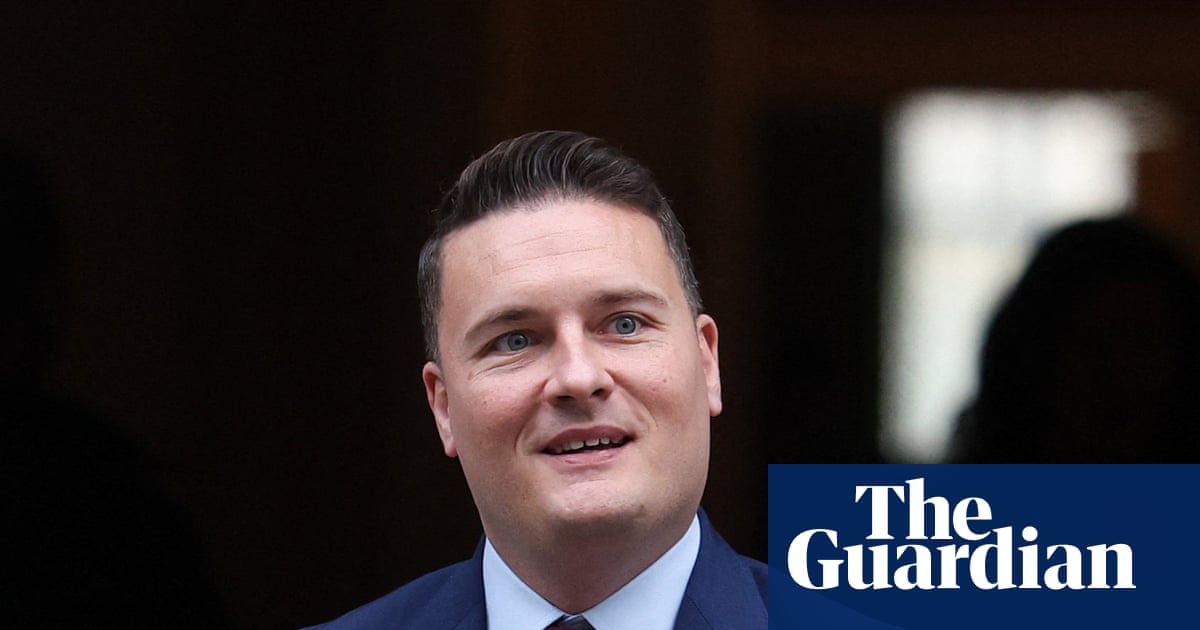
Wes Streeting has admitted he is not comfortable with forcibly deporting families under the home secretary’s migration plans, while maintaining it is still the right thing to do.
The health secretary said he thought the number of forced removals would be low under the proposed model, which is similar to Denmark’s, because there would be an increased financial incentive for people entering the UK illegally to return to their country of origin.
When pressed on whether he was comfortable with a policy that dozens of Labour MPs oppose, however, Streeting said: “Honestly? Comfortable? No. But is it the right thing to do for the country? Yes.”
In an interview with LBC, he said Shabana Mahmood was “making sure that we, where people have got no right to be here, that we are deporting them, but also supporting them to be relocated as well … so actually the number of forced removal should be low”.
Streeting’s comments appeared to signal that he has sympathy with some of the worries of Labour MPs, with two dozen having raised concerns about families being forcibly removed if they refuse cash incentives to return to their own country.
Keir Starmer and Mahmood are facing the threat of a revolt over the policy at a time when the soft left of the party is expressing growing discontent with Labour’s leadership.
The policy also came in for criticism internationally on Wednesday when Albania’s prime minister, Edi Rama, accused Mahmood of “ethnic stereotyping” and “indecent demagoguery”.
Rama, who leads the country’s Socialist party, questioned how a Labour politician could “so poorly echo the rhetoric of the populist far-right” after Mahmood’s officials singled out 700 Albanian families for deportation.
He wrote on X: “How can a Labour home secretary so poorly echo the rhetoric of the populist far-right – and single out 700 Albanian families, a statistical drop in the ocean of post-Brexit Britain’s challenges – precisely at a moment when the UK and Albania have built one of Europe’s most successful partnerships on illegal migration?
“Albanians are net contributors to the British economy, and the number of Albanians receiving UK benefits is very low relative to other communities. To single them out again and again is not policy – it is a troubling and indecent exercise in demagoguery.
“The UK should be seeking ways to deepen cooperation with Albania on all security issues – from defence to border protection – rather than repeatedly scapegoating Albanians and thereby exposing citizens of an allied nation to increased risks, including from extremist groups that thrive on such narratives. Official policy should never be driven by ethnic stereotyping.”
An Albanian government source said there were growing tensions between the Albanian and UK governments despite successful collaboration over immigration policies.
Rama’s attack has also caused discomfort in Whitehall, because the western Balkans are seen as a major transit route for asylum seekers attempting to reach the UK.
UK border security officers were sent to Albania, Serbia, Montenegro, Kosovo, North Macedonia and Bosnia and Herzegovina over the summer to build links and gain intelligence on smuggling gangs, it has been confirmed.
Announcing her new asylum policy on Monday, Mahmood said: “We must remove those who have failed asylum claims, regardless of who they are.
“Today, we are not removing family groups, even when we know that their home country is perfectly safe. There are, for instance, around 700 Albanian families living in taxpayer-funded accommodation having failed their asylum claims – despite an existing returns agreement, and Albania being a signatory to the European Convention on Human Rights.
after newsletter promotion
“So we will now begin the removal of families. Where possible, we will encourage a voluntary return, but where an enforced return is necessary, that is what we will do.”
The Home Office has claimed there are about 700 Albanian families in the UK with no right to be here but until now the Home Office has chosen not to prioritise sending them home.
Albanian asylum claims remain low, and there has been more than a 90% drop in Albanian small-boat arrivals since 2022.
Andi Hoxhaj, an associate fellow from the Royal United Services Institute (RUSI), said the UK government appeared to be targeting and singling out Albanians in its rhetoric.
He said: “We saw the same issue under the previous Conservative administration and both the Albanian community and the Albanian government are deeply frustrated by the return of this narrative.
“This rhetoric seems increasingly tied to the government’s push to reinterpret or reform ECHR provisions on family rights – using Albanians as an example to make a broader political argument, like the Reform and Conservatives have made by using Albanians as an example.
“By specifically naming Albania, the home secretary is also responding to Farage’s messaging, as he has made Albanians a central part of his rhetoric.”
This is not the first time that Rama, one of Europe’s more flamboyant leaders who knelt while greeting the Italian prime minister, Giorgia Meloni, at an EU summit in May, has criticised a UK home secretary.
In November 2022 he accused Suella Braverman of “fuelling xenophobia and targeting, singling out a community” when she accused some Albanians of abusing modern slavery laws.
Mahmood’s office has been approached for a comment.
